
In this article, you'll find practical calculation examples, a table with minimum rates by category, and essential tips for setting a fair and sustainable babysitter salary.
According to data from platforms like Sitly and specialized agencies, in 2026 the average hourly rate for a babysitter in Brazil is around R$18 to R$30. However, this amount can vary quite a bit depending on the city, the professional’s experience, and the responsibilities involved.
In practice, rates can start at R$15 per hour for students or beginner caregivers, and exceed R$35 per hour for babysitters with specific training, first aid courses, and experience with newborns or children with special needs.
The type of babysitter also directly affects the cost:
- A professional with years of experience and training in pedagogy or pediatric nursing will naturally charge more.
- An 18-year-old university student who works as a babysitter occasionally tends to charge less.
Beyond experience, it’s important to consider the labor rights guaranteed by Brazilian law, such as minimum wage, INSS, vacation pay, 13th salary, and FGTS. Even in informal arrangements, these costs should be factored in when setting fair and sustainable pay for a babysitter.
Looking for a good babysitter near you? Post a free ad on Sitly and receive messages from babysitters available in your area.
What is the legal minimum wage for babysitters in Brazil?
In Brazil, the babysitter profession is regulated by Complementary Law No. 150/2015, which governs domestic work. According to this legislation, babysitters with a fixed schedule must be hired with a signed work permit (carteira assinada), with rights to minimum wage (national or state, as applicable), night shift premium, vacation pay, 13th salary, FGTS, and INSS.
In 2026, the national minimum wage is R$1,621.00, which is equivalent to about R$7.37 per hour considering a monthly workload of 220 hours. However, in states such as São Paulo and Rio de Janeiro, the regional minimum wage is higher, and can exceed R$1,800.00 per month.
Beyond the base salary, the real cost for the family includes:
- INSS contribution (8%);
- Mandatory FGTS (8%);
- Vacation pay + constitutional 1/3 bonus;
- Proportional 13th salary;
- Transportation vouchers, when needed.
In other words, even if the babysitter receives the minimum wage, the real hourly cost for the employer can reach R$10–12, once all legal charges are factored in.
Monthly babysitter or hourly babysitter: which is the better option?
When hiring someone to look after their children, many parents wonder: is it better to go with a monthly babysitter, or pay by the hour as needed?
A monthly babysitter (babá mensalista) works fixed hours, usually Monday to Friday, under a formal contract (CLT or private agreement). She receives a fixed monthly salary, regardless of variations in the number of hours worked each week. This arrangement offers more stability, both for the family and the professional, and usually includes benefits such as paid vacation, 13th salary, and INSS and FGTS contributions — especially in formal hiring arrangements.
An hourly babysitter (babá horista), on the other hand, is ideal for those who need occasional help: weekends, evenings out, or emergency situations. Payment is made per hour worked, and there is usually no fixed contract. Although the hourly cost is higher, this option offers parents more flexibility, without the need to maintain an ongoing arrangement.
Practical summary:
- If you need daily support and want to ensure commitment and stability, a monthly babysitter is the right choice.
- If you only need occasional help, an hourly babysitter is more economical and flexible.
What is the cost of a daily babysitter?
If you only need help for a single day or on an occasional basis, hiring a daily babysitter (babá diária) may be the best solution. This professional works a full shift, generally between 8 and 10 hours, without any fixed commitment to the family.
Average rate:
- In large cities such as São Paulo or Rio de Janeiro, the average cost ranges between R$150 and R$220 per day, depending on experience, number of children, and whether extra tasks are involved (such as cooking or school pickup).
- In smaller cities, the range usually varies from R$100 to R$150 per day.
Important:
- Since there is no fixed contract, this type of arrangement usually does not include benefits such as INSS, vacation pay, or 13th salary.
- Payment can be made via PIX, cash, or a simple receipt (RPA), and in some cases it’s possible to claim an income tax deduction using the babysitter’s CPF, if registered.
How experience and qualifications influence a babysitter’s rate
A babysitter’s skills and professional background carry significant weight in determining what she charges — and what she expects to be paid. And it’s not just about age:
- A 24-year-old student with training in Early Childhood Education or pediatric first aid certification will naturally charge a higher hourly rate.
- But a 19-year-old with extensive experience caring for children of different ages can also justify a rate above the going minimum.
Generally speaking, the more experienced or qualified the babysitter, the higher her hourly rate tends to be. Many professionals today hold additional certifications, such as pediatric first aid, Montessori training, or studies in Psychology or Education — and all of this contributes to a higher rate.
As the parent, the choice is personal:
Would you rather work with someone less experienced, at a more affordable rate?
Or are you willing to pay more for a professional with specific training, who offers greater safety and peace of mind?
There’s no right or wrong answer: what matters most is that the agreed rate is fair for both parties, and that you feel confident the babysitter can care for your children well and safely.
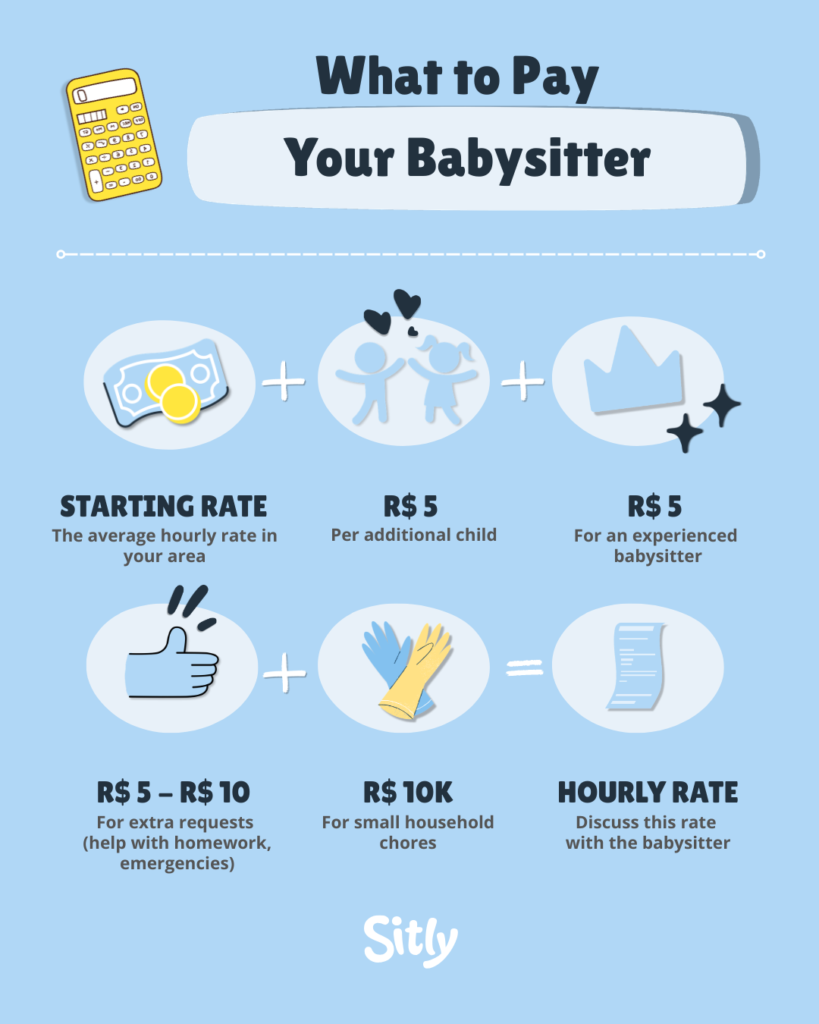
What are your babysitter’s tasks?
The hourly rate for a babysitter doesn’t just depend on age or experience, but also on the tasks she carries out on a day-to-day basis. If you expect the professional to take on extra responsibilities, it’s only natural that her pay should increase accordingly.
Here are some practical examples:
- Looking after several children at once: taking care of two or three children requires much more attention and energy than caring for just one. For this reason, it’s worth factoring in an additional payment.
- Children with special needs: if your child requires constant care, follows a specific routine, or needs differentiated attention, the babysitter needs to be prepared for this — and her pay should reflect this level of responsibility.
Example: experienced babysitter, 3 children, meal preparation
Letícia is 19 years old, studying Education, and holds a pediatric first aid certificate. She already has good experience as a babysitter and, once a week, looks after three children (aged 8, 5, and 3) for the same family.
Her routine is as follows: she arrives at 4 p.m. and picks the children up from school, takes them to the park, and gives them their afternoon snack. At home, she prepares dinner and organizes mealtime. The parents arrive around 7:30 p.m.
What’s a Fair Rate for Leticia? Breakdown of her rate:
- Base hourly rate (informal work, with experience): R$20.00
- Additional for caring for more than one child: +R$2.00/hour
- Additional for meal preparation and certification: +R$1.00/hour
- Total per hour: R$23.00
Total for a 3.5-hour shift: R$23.00 × 3.5 = R$80.50
Babysitter’s hourly rate: the age of the children matters
The age of your children is an important factor when deciding how much to pay the babysitter.
- Babies and young children (up to 3 years old) require constant attention, diaper changes, assisted feeding, and delicate care. For this reason, babysitters who look after children in this age group tend to charge higher hourly rates.
- Children aged 6 and up are more independent: they can already eat by themselves, use the bathroom without help, and often manage to entertain themselves. This reduces the babysitter’s workload, which allows for a somewhat more affordable rate.
The younger and more dependent the child, the greater the professional’s responsibility — and therefore, the higher the pay should be.
Extra pay for light household tasks
Some small tasks are part of a babysitter’s routine — such as tidying the children’s room after playtime, preparing their dinner, or washing the dishes they used. But if you expect the babysitter to also help with light household chores that go beyond childcare, it’s fair to pay an additional amount for this.
Examples of tasks that may justify extra pay:
- Loading or unloading the dishwasher;
- Hanging or taking down laundry from the clothesline;
- Washing dishes after meals;
- Preparing the children’s dinner;
- Vacuuming;
- Dusting furniture and toys.
Keep in mind: these tasks are not part of a babysitter’s core role, but rather that of a house cleaner. Considering that a house cleaner in Brazil charges on average between R$120 and R$180 per day (or around R$20–25 per hour), it’s fair to offer a comparable additional amount when the babysitter also helps out with household chores.
Daytime or nighttime babysitter: does it change the rate?
Do you need a babysitter just for the evening? Or someone to look after the children for the whole afternoon, with a full routine?
Generally speaking, a nighttime babysitter tends to charge more. This happens because the professional:
- Works outside of regular hours;
- Needs to be available at less conventional times;
- Often has to travel home late at night.
Daytime work (especially in the afternoon), on the other hand, usually includes:
- Picking the children up from school;
- Taking them to extracurricular activities;
- Preparing light meals;
- Supervising bath time and rest;
- Playing, supervising, and helping with the day’s tasks.
Since it involves more steps and effort, the afternoon period can involve a greater volume of work, even if the hourly rate isn’t as high as it is at night.
Example: Mariana, 19 years old, occasional nighttime babysitter
Mariana is 19 years old and a university student. She has been working as a babysitter for two years, starting out with her younger brother and cousins. On weekends, Mariana works as an occasional nighttime babysitter for one family.
When she arrives at 7:30 p.m., the children have already had dinner. Her main task is putting them to bed around 8:30 p.m. After that, she stays at the house until 11:30 p.m. — and the parents drive her home. During the evening, the only extra task is emptying the dishwasher; the rest of the time, she can rest while the children sleep.
What’s a reasonable rate for Mariana?
Together with the parents, she agreed on a rate of R$20.00 per hour, which reflects the fact that the effort required is low and the children go to bed early.
Total for the evening
R$20.00 × 4 hours = R$80.00
Rate for last-minute babysitters
Do you need a babysitter at short notice? That flexibility comes at a cost. Emergency calls often mean the babysitter has to cancel personal plans or rearrange her entire schedule, especially if she’s a student. In these cases, it’s fair to offer a higher hourly rate. After all, immediate availability is convenient for the family, but the professional’s flexibility should be acknowledged and well compensated.
Example: Laura, occasional last-minute babysitter
Laura has an arrangement with a family to be a backup babysitter for morning emergencies. One day, at 6:45 a.m., Pedro’s mother calls to let her know that her son has a fever and won’t be able to go to daycare, but she has an important meeting at work.
Laura arrives at 8 a.m. and stays with Pedro until 1 p.m., when the grandmother arrives to take over.
What’s a reasonable rate for Laura?
- R$20.00/hour = the base rate typically charged by experienced babysitters without a formal arrangement
- R$4.00/hour = urgency surcharge (+20%)
Total per hour: R$24.00
5-hour shift: R$24.00 × 5 = R$120.00
Many families choose to round this up to R$130.00, as a way of saying thank you for her readiness. This helps the babysitter feel valued, and the parents know they can count on her in emergency situations.
Hourly rates for babysitters in Brazil: average by city
Rates charged by babysitters in Brazil vary quite a bit from one city to another, influenced by factors such as cost of living, local demand, and the number of professionals available.
Below is an estimate of average hourly rates in some Brazilian capital cities:
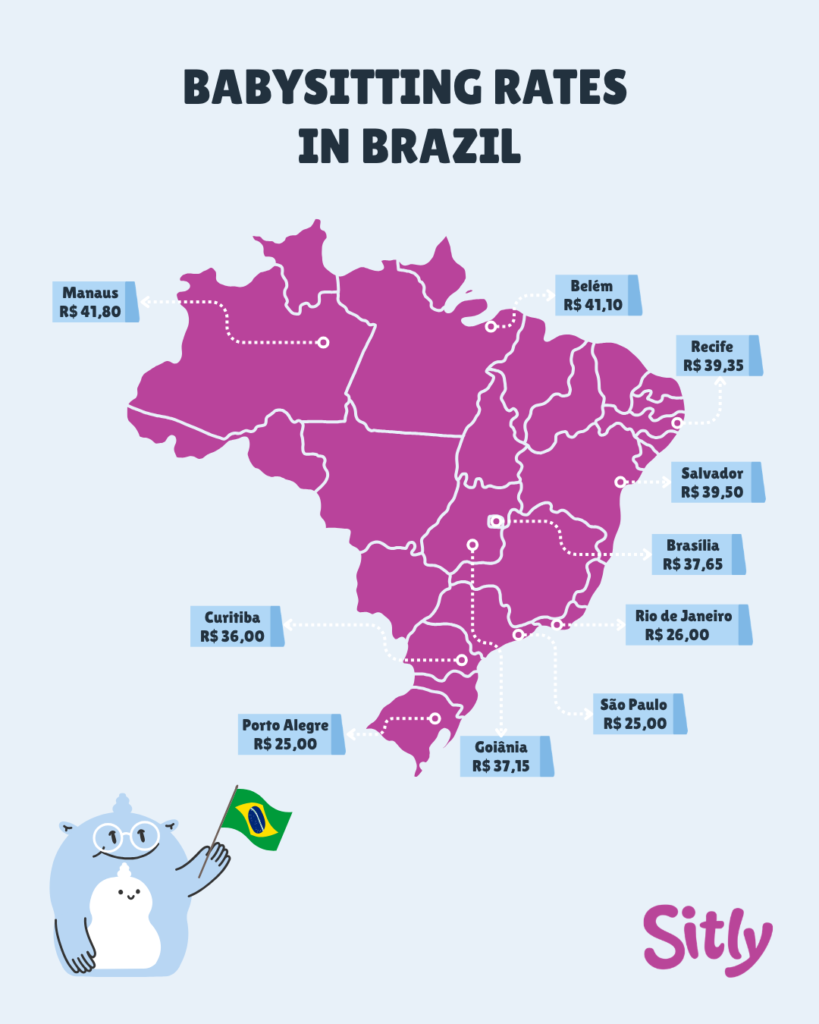
Why do rates vary?
- In cities with many babysitters available but low demand, prices tend to drop.
- On the other hand, where there are many families looking for help and few qualified professionals, the hourly rate naturally goes up.
How do you know what’s fair? To set an appropriate rate, it’s worth talking to parents in your area, neighbours, or friends with young children. This helps give you a realistic sense of what’s being paid and lets you propose a fair rate, in line with the market and the babysitter’s profile.
Average hourly rate for babysitters in Brazil
| City | Average Babysitting Hourly Ratea |
|---|---|
| Manaus | R$41,80 |
| Belém | R$41,10 |
| Recife | R$39,35 |
| Salvador | R$39,50 |
| Brasília | R$37,65 |
| Goiânia | R$37,15 |
| Rio de Janeiro | R$26,00 |
| São Paulo | R$25,00 |
| Porto Alegre | R$25,00 |
| Curitiba | R$36,00 |
So, how much should you pay your babysitter?
There’s no single answer to this question. The fair amount depends on a number of factors, such as:
- The babysitter’s age, experience, and qualifications;
- The number of children and each one’s age;
- Any additional tasks involved;
- Whether the work is during the day, at night, or on call;
- The city where you live;
- And, of course, your budget.
At the end of the day, it’s about finding the right balance between the babysitter’s expectations for fair pay and your family’s real needs. The most important rule is communication: talk openly about your expectations, the responsibilities involved, and the amount available. Together, you can reach an agreement that’s fair for both sides — and ensure a relationship built on trust and peace of mind when it comes to caring for your children.
Table of contents


FAQs

Most babysitters in Canada earn between CAD 15 and 20 per hour, but the exact rate depends on several factors, including age, experience, location, and special skills.
Yes—many families increase the hourly rate for times that are considered less convenient or higher demand.
-
Evenings: +CAD 1–3/hour
-
Weekends: +CAD 2–5/hour
-
Holidays: the highest premiums, sometimes +CAD 5–10/hour
Families are generally willing to pay more during these periods because babysitters give up personal time, and the availability of other sitters is lower.
For most babysitters, hourly rates are the best option, especially for short or unpredictable shifts.
However, flat rates can be helpful in certain scenarios:
-
Overnight care (e.g., CAD 80–120 for the night, depending on expected duties)
-
Long bookings (4–8 hours) where families prefer a single predictable cost
When choosing, babysitters should ensure the flat fee still results in fair hourly compensation and covers any tasks required (meals, bedtime routine, etc.).
Absolutely. Certifications are one of the strongest leverages for higher pay.
Popular ones in Canada include:
-
Red Cross Babysitting Course
-
CPR & First Aid Certification
-
Childcare/early childhood education experience
Babysitters with one or more certifications are trusted more and can typically charge CAD 2–4/hour more than uncertified sitters.
Rates generally increase as the number of children goes up, because the job becomes more demanding.
A common structure is:
-
Base rate: for the first child
-
+CAD 2–5/hour: per additional child
The exact increase depends on the children’s ages, whether they require special care, and how many activities or routines the babysitter must manage.
For three or more children, some sitters move from an hourly rate to a flat rate to simplify plannin


Flexible babysitting jobs, just around the corner
Love spending time with kids? Become a Sitly Sitter! We connect you with families looking for a reliable sitter. Set your own schedule, choose your rates, and meet families nearby. Get started today!

Related Articles

Calculate Your Babysitter’s Rate with the Sitly Calculator
Find out how much to pay a babysitter in your area. Sitly’s Babysitter Rate Calculator shows average rates across Brazil and helps you estimate a fair hourly wage based on your city, number of children, and any extra duties.

16 Easy Part-Time Jobs as a Student — from Babysitting to Tutoring and Private Lessons
Seeking to earn some extra money as a student or in addition to your current job? In this guide, we’ve rounded up16 of the best and most flexible side jobs.

How to Become a Great Babysitter
If you want to become a babysitter and find regular work, the key is to build experience, gain parents’ trust, and show that you take the role seriously. Even if you’re young, you can start by helping family members, offering to work as a “mother’s helper,” taking a First Aid and CPR course, and creating a professional babysitter profile on a platform like Sitly. By setting a fair hourly rate based on your age, experience, and responsibilities, and by going the extra mile during each job, you’ll increase your chances of getting more babysitting work and keeping parents happy.