
Do you work as a babysitter, or want to get started in the field? In this guide, you'll find updated 2026 rates, the average hourly wage, and practical examples to help you calculate how much to charge, taking into account your experience, city, and type of work.
Have you landed a job as a babysitter but aren’t sure how much to charge per hour? Or are you already working and want to know if your pay is in line with the average? In Brazil, according to data from platforms like Sitly and specialized agencies, in 2026 the average hourly rate for babysitting work is around R$18 to R$30.
However, this figure is only a reference point, since a babysitter’s pay can vary quite a bit depending on the city, the professional’s experience, the tasks included, and the number of children in her care. There are also minimum amounts set by law, based on the domestic work contract and level of qualification, which serve as a baseline for calculating fair pay.
In this guide, you’ll find all the information you need to understand how much to charge as a babysitter, how to calculate your hourly rate, and when it’s possible to ask for a higher amount based on your experience and responsibilities.
How much does a babysitter earn per hour?
As we’ve seen, the average hourly rate for a babysitter in Brazil in 2026 is between R$18 and R$30, according to Sitly data. However, this amount can be higher or lower depending on several factors. The starting point for calculating how much to charge as a babysitter is the minimum amounts set out in labour law — these serve as a reference to ensure your work is recognized and properly valued. Beyond that, other elements come into play that directly affect your pay:
- the city or region where you work;
- your level of experience and professional training;
- the number and age of the children;
- the timing of the work (during the day, at night, or on weekends);
- and the type of arrangement with the family (fixed or occasional work).
In the following sections, we’ll show you how to calculate a fair daily rate for babysitting, understand what the law says, and find out how much an experienced babysitter earns in Brazil.
What is the legal minimum wage for babysitters in Brazil
If you work as a babysitter, it’s important to know what your rights are and what the minimum amount you should be paid for your work is. The babysitter profession falls under domestic work and is regulated by Complementary Law No. 150/2015. This means that if you work fixed hours, you must be hired with a signed work permit (carteira assinada) and receive all the benefits provided for by law.
In 2026, the national minimum wage is R$1,621.00, which corresponds to about R$7.37 per hour over a monthly workload of 220 hours. However, this amount can be higher depending on the state. In places like São Paulo and Rio de Janeiro, for example, the regional minimum wage can exceed R$1,800.00 per month. Beyond the base salary, the hiring family must also cover labour charges, such as:
- INSS contribution (8%)
- Mandatory FGTS (8%)
- Vacation pay with a one-third bonus
- Proportional 13th salary
- Transportation vouchers, when needed
Knowing these rules helps you understand how much you’re entitled to receive and negotiate your pay with confidence and transparency.
Example: experienced babysitter, 3 children, meal preparation
Letícia is 19 years old, studying Education, and holds a pediatric first aid certificate. She already has good experience as a babysitter and, once a week, looks after three children (aged 8, 5, and 3) for the same family. Her routine is as follows:
Arrives at 4 p.m. and picks the children up from school, takes them to the park, gives them their afternoon snack. At home, prepares dinner and organizes mealtime.
What’s a Fair Rate for Leticia? Breakdown of her rate:
- Base hourly rate (informal work, with experience): R$20.00
- Additional for caring for more than one child: +R$2.00/hour
- Additional for meal preparation and certification: +R$1.00/hour
- Total per hour: R$23.00
- Total for a 3.5-hour shift: R$23.00 × 3.5 = R$80.50
How much does a babysitter earn per hour in Brazil’s major cities
The minimum amounts we looked at earlier are a good reference point, as they help you understand what a fair pay range would be for your work as a babysitter.
However, the actual rate is usually agreed upon between the family and the professional, and can vary quite a bit depending on several factors.
One of the factors that has the biggest influence is the city where you work. Hourly babysitting rates change a lot from one region to another. For example, a babysitter in São Paulo generally earns more than one in Recife or Salvador, but it all depends on the type of service. If you look after two young children, have proven experience, or hold some specific training, you may end up earning more even in cities where the average is somewhat lower.
In the image below, you can see how much a babysitter earns per hour in different Brazilian cities. This information helps you determine how much to charge as a babysitter, taking into account your experience and the cost of living in your region.
Infographic: how much does a babysitter earn in Brazil
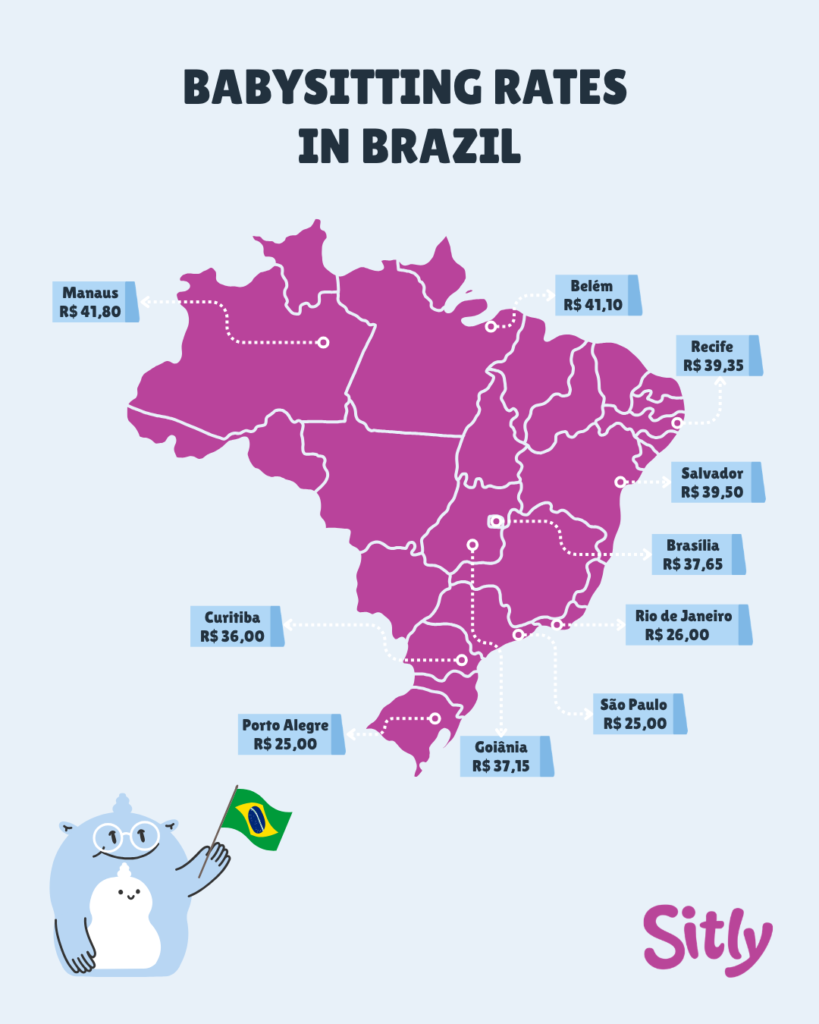
Average hourly rate for babysitters in Brazil
| City | Hourly rate |
|---|---|
| Manaus | R$41.80 |
| Belém | R$41.10 |
| Recife | R$39.35 |
| Salvador | R$39.50 |
| Brasília | R$37.65 |
| Goiânia | R$37.15 |
| Rio de Janeiro | R$26.00 |
| São Paulo | R$25.00 |
| Porto Alegre | R$25.00 |
| Curitiba | R$36.00 |
How to calculate a babysitter’s pay
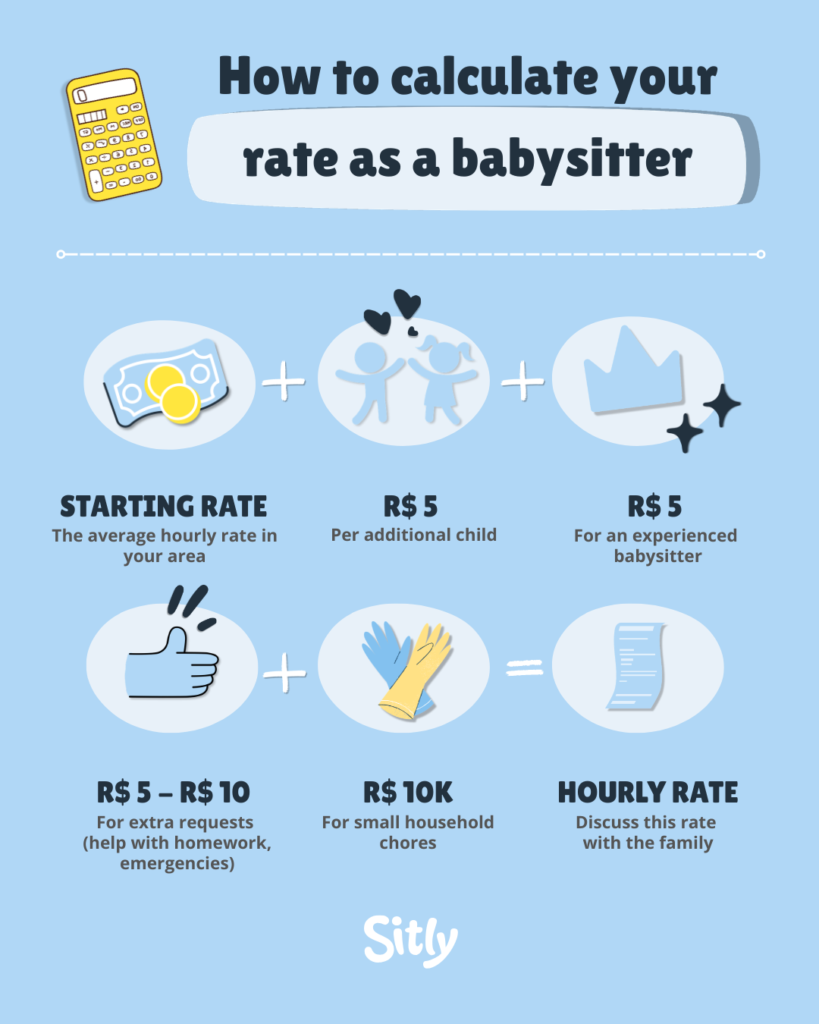
Besides the city where you work, there are many other factors that can help you earn more as a babysitter: your experience, qualifications, the number of children you look after, and any extra tasks the family asks you to do. All of this directly affects your hourly rate and your final pay.
Below, you’ll find an infographic showing how to calculate a fair hourly or daily rate as a babysitter, taking into account the type of work, the hours involved, and the responsibilities you take on for the family.
You might also be interested in our article on how to be a good babysitter, with plenty of tips for being professional and building a good relationship with the family.
Infographic: how to calculate a babysitter’s pay
How much does a babysitter with experience and qualifications earn
If you’ve been working with children for several years, or hold a specific qualification (such as an early childhood educator, daycare assistant, nursing technician, or child carer), you can ask for a higher amount than the minimum. Families tend to recognise and value a babysitter who shows professionalism, reliability, and educational skills, and they’ll often offer higher pay for this kind of experience.
How much does a babysitter earn per hour looking after two children
When the job involves two or more children, hourly pay generally increases by 10% to 20% compared to the base rate. Looking after two young siblings, for example, requires more attention and energy than caring for a single older child.
And if the children are quite different ages, balancing activities and giving attention to each one can be even more challenging — which justifies a higher hourly rate.
Babysitter pay with light household tasks
Tidying the children’s room, preparing lunch, washing dishes they’ve used, or folding their clothes are all part of a babysitter’s normal duties.
However, if the family asks you to do other household chores, such as washing or hanging out the household laundry, dusting, or vacuuming, this should be paid as an extra service, since these tasks go beyond childcare.
Pay for a babysitter who uses her own car
Many babysitters take children to school, swimming lessons, or other activities and then bring them back home. If you use your own car for these trips, it’s important to agree with the family on a fixed weekly or monthly reimbursement to cover fuel costs and vehicle use.
How much does a babysitter earn at night or on the night shift
Nighttime babysitting work tends to offer somewhat better pay, since it involves more tiring and less convenient hours. Generally speaking, for looking after children at night, you can charge 10% to 20% more than your usual daytime rate. For example, if you earn R$20 per hour during the day, you might charge between R$22 and R$24 at night, especially if the work is after 10 p.m. or if you need to sleep over at the family’s home.
That said, the rate also depends on the type of work. If you arrive after the children have already had dinner, and they go to sleep shortly after and have a quiet night, you might accept a somewhat lower rate.
On the other hand, if the children are young or wake up several times and you need to stay alert during the night, it’s fair to ask for a higher amount.
Safety tip: Before starting the job, agree with the parents on how you’ll get home at night. Will they drive you? Will they pay for a taxi? Or will they walk you to your car? Your safety should always come first, and this should be something clearly agreed upon with the family.
Example: Mariana, 19 years old, occasional nighttime babysitter
Mariana is 19 years old and a university student. She has been working as a babysitter for two years, starting out with her younger brother and cousins. On weekends, Mariana works as an occasional nighttime babysitter for one family.
When she arrives at 7:30 p.m., the children have already had dinner. Her main task is putting them to bed around 8:30 p.m. After that, she stays at the house until 11:30 p.m. — and the parents drive her home. During the evening, the only extra task is emptying the dishwasher; the rest of the time, she can rest while the children sleep.
What’s a reasonable rate for Mariana?
Together with the parents, she agreed on a rate of R$20.00 per hour, which reflects the fact that the effort required is low and the children go to bed early.
Total for the evening: R$20.00 × 4 hours = R$80.00
Mariana is satisfied: the evening goes smoothly and the rate is fair. The parents are happy too, since they know they’ve made a clear agreement suited to the reality of the service provided.
Babysitter pay: is it better to be paid hourly or with a fixed monthly rate?
It’s common to wonder whether it’s better to be paid by the hour or with a fixed monthly amount. The answer depends on the type of work you do for each family. If your work is occasional, with hours that change from week to week, it’s best to agree on an hourly rate. This way, you’re paid exactly for the time worked and keep flexibility in your days and hours.
But if you work on a fixed, ongoing basis for a single family, it may be more practical to set a fixed monthly amount. In this case, it’s important to be very clear about what’s included in that amount:
- If the family doesn’t need you on a particular day, does the pay stay the same?
- If they ask you to stay an extra two hours, will those hours be paid separately?
- What happens when a month has more working days (for example, five Tuesdays instead of four)?
It’s best to agree on all these details right at the start, to avoid misunderstandings and maintain a smooth, professional relationship with the family.
Babysitter rate for last-minute calls
And what about when the family suddenly calls asking for help? For example, early in the morning, because their child has fallen ill and can’t go to school. In these urgent or last-minute situations, it’s common to charge a somewhat higher rate, between 10% and 20% above your usual amount.
It’s best to agree on an urgency rate in advance, one that applies whenever the family needs you unexpectedly. This way, everything is clear, and your availability and flexibility are properly recognised and valued.
Example: Laura, occasional last-minute babysitter
Laura has an arrangement with a family to be a backup babysitter for morning emergencies. One day, at 6:45 a.m., Pedro’s mother calls to let her know that her son has a fever and won’t be able to go to daycare, but she has an important meeting at work. Laura arrives at 8 a.m. and stays with Pedro until 1 p.m., when the grandmother arrives to take over.
How much does Laura earn?
- R$20.00/hour = the base rate typically charged by experienced babysitters without a formal arrangement
- R$4.00/hour = urgency surcharge (+20%)
- Total per hour: R$24.00
5-hour shift: R$24.00 × 5 = R$120.00
Many families choose to round this up to R$130.00, as a way of saying thank you for her readiness. This helps the babysitter feel valued, and the parents know they can count on her in emergency situations.
How much does a babysitter earn per month
The amount a babysitter earns per month can vary quite a bit, depending on hours worked and professional experience. A part-time babysitter, for example, working around 20 hours a week, might earn between R$1,500 and R$2,000 per month. Someone working full-time with qualifications or experience with babies and young children, especially in cases requiring more attention, can earn upwards of R$3,000 per month.
Some babysitters who take on more responsibilities, or who live with the family, may earn even more, but in these cases the arrangement is usually formalised, with a signed work permit, vacation pay, 13th salary, and INSS contributions.
How much does a babysitter earn per day
If you only work certain days of the week, for example during school holidays or when the parents are travelling, it may make sense to agree on a daily rate instead of an hourly one.
The calculation is simple: multiply your hourly rate by the total number of hours in the day.
An 8-hour shift, for example, typically brings in between R$160 and R$240 per day, depending on your experience and the tasks involved. This amount can be higher if you look after young children, prepare meals, or stay into the evening.
Tip: agree with the family on the working hours, the activities you’ll carry out, and how you’ll be paid if you need to stay beyond the agreed time.
This way, everything is clear, and the working relationship stays smooth and transparent.
How to set your rate as a babysitter
To decide how much to charge as a babysitter, take a few important factors into account:
- your experience and qualifications;
- the number and age of the children;
- the average rates in your city;
- the timing of the work (day, night, or weekend);
- and any additional responsibilities the family expects of you.
Once you’ve worked out a fair amount, the next step is to talk openly with the family. At first, it can feel a bit awkward to talk about money, but being clear from the start is the best way to avoid misunderstandings and begin the working relationship on a professional footing.
A good way to approach the topic is to come prepared: research rates in your area, and during the conversation, calmly explain your rate and the reasons behind it — such as the number of children, the hours involved, or extra tasks. You can also ask the family what amount they had in mind. This keeps the conversation open and balanced, making it easier to reach an agreement that’s fair for both sides.
Table of contents


FAQS

In 2025, most parents in Canada pay between $16 and $22 per hour for a babysitter. Rates vary depending on your location, the sitter’s experience, and the number of children. In big cities like Toronto, Vancouver, and Ottawa, babysitters often charge closer to $20–$25 per hour, while smaller towns or rural areas may see rates around $15–$18. If your babysitter has first aid certification, childcare training, or many years of experience, expect to pay at the higher end.
The average babysitting rate in Canada is around $18 per hour, according to Sitly’s data. However, the national average hides big regional differences — for example, Vancouver and Toronto often have the highest rates, while cities like Winnipeg or Halifax are slightly lower. Many families also adjust pay based on the sitter’s age, reliability, and duties (like bedtime routines, meal prep, or homework help). For occasional babysitting, parents typically pay hourly; for regular weekly help, some negotiate a flat rate.
Yes, most babysitters increase their rate when caring for more than one child. The typical increase is $1–$3 extra per hour per additional child, depending on their ages and needs. For instance, managing a baby and a toddler at the same time often requires more attention than watching two older kids. Some babysitters set a flat hourly rate that covers up to two children, and then add a small supplement for each extra one. Discussing expectations early — including mealtimes, bedtime, and any special routines — helps avoid misunderstandings and ensures fair pay for the workload.
Overnight babysitting rates in Canada depend on how many active hours are required. Many parents pay a flat fee between $80 and $150 per night, or an hourly rate until bedtime (usually $18–$22/hour) plus a reduced hourly rate for sleeping hours. If the sitter needs to wake up to feed a baby or attend to young children during the night, it’s fair to increase the total amount. Providing meals, a comfortable sleeping space, and transportation is also standard. For regular overnight care — such as when parents work night shifts — a negotiated weekly rate can be more practical.
Babysitter rates in Toronto and Vancouver average $22–$27 per hour, among the highest in the country. The higher cost of living and strong demand for reliable childcare increase rates, particularly for sitters with CPR certification or childcare experience.


Trusted sitters, right around the corner
Need a little help? Sitly connects you with experienced babysitters in your area. Whether you need occasional or regular care, finding the right babysitter is super easy. Browse profiles, read reviews, and reach out to your favorites right away.

Related Articles

Calculate Your Babysitter’s Rate with the Sitly Calculator
Find out how much to pay a babysitter in your area. Sitly’s Babysitter Rate Calculator shows average rates across Brazil and helps you estimate a fair hourly wage based on your city, number of children, and any extra duties.

10 Ways to Help Your Child Overcome Fear of Monsters at Bedtime
If your child is afraid of monsters at bedtime, you’re not alone. Many kids aged 3 to 6 struggle with nighttime fears fueled by imagination and change. In this article, you’ll learn why these fears happen, how to validate them, and 10 simple, creative ways to help your child feel safe and sleep peacefully. From using nightlights and comforting routines to anti-monster sprays, magic spells, and stuffed animal bodyguards—each idea is designed to reduce anxiety and empower your child at night.

From What Age Can You Safely Leave Your Child Home Alone?
Learn what your child should know before staying home alone, how to plan for emergencies, and how babysitters can support independence too.